I’ve fallen victim to spending countless hours trying to answer stupid questions or answer the unanswerable. I believed it was my duty as a person to carefully evaluate every statement thrown my way and carefully analyze it to discern whether I should throw it away or accept it.
I think this is a common habit. Usually it is considered praiseworthy or respectable to do so because doing this means you are evaluating opposite perspectives, and implied in this is that you are growing and learning.
I’m now of the opinion that this is the incorrect way to approach thought. We are all familiar with the fact that often when you present contrary evidence to someone, they are more likely to bolster their beliefs than to change their mind.
This feeling of duty arises because we do not understand the fact that sentences are not evaluated independently, but always in comparison with the whole. This is an important insight to internalize, be aware of, and use.
The aforementioned “mental virtue” of appraising every thought is extremely dangerous. The school of thought that says to inspect every thought no matter what treats thought like a no-lose proposition. It almost treats thinking like it has no end goal; the point of thinking is to think, or in common parlance, “it’s about the journey”.
This is dangerous because firstly, it has the danger of potentially introducing corrupted thoughts into one’s system of beliefs, secondly, thought does have a point, and thirdly, it doesn’t recognize either of these things.
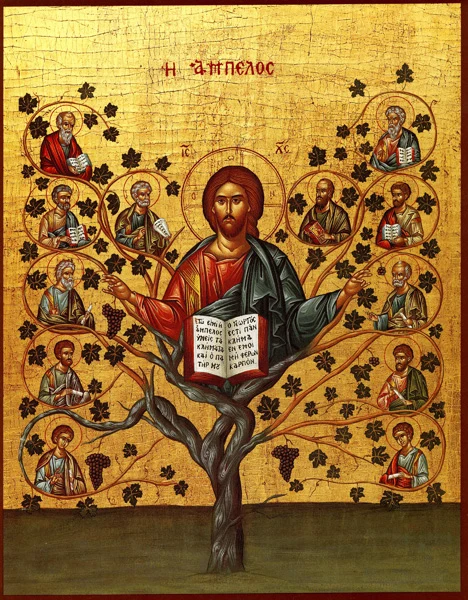
My first argument offers another view on thought, which is that thought is a whole thing and is systematized. It is not made up of independent clauses and beliefs. This has been given to us by Christ.
43 “For a good tree does not bear bad fruit, nor does a bad tree bear good fruit. 44 For every tree is known by its own fruit. For men do not gather figs from thorns, nor do they gather grapes from a bramble bush.
To narrow the focus of the words of the Lord to this topic, with the addendum that this by no means exhausts the meaning of what the Lord says, the imagery of a tree is used to demonstrate that fruit (thought) is connected to trees (system).
This is demonstrable in that certain pieces of evidence are not interpreted the same way. Some Christians can read John 6 and think Christ is not talking about being the fulfillment of the Passover Lamb, whereas others interpret John 6 as affirming the Eucharist. The same evidence is provided, but different underlying beliefs shape how that evidence is interpreted.
So, if we understand belief as being structural, it makes sense to then say certain thoughts or beliefs can be introduced which will corrupt the tree. A thought which contains bad content can be thought of as “just” an independent thought that has nothing to do with the tree, or it can be thought of as introducing a harmful species of insects to our tree bearing good fruit.
The latter understanding is how bad thoughts should be understood. They are not an innocent, lexically independent string of symbols, but things which contain the potential to infect (or grow) a tree. Thoughts are a truly risky thing to hold and behold, and it’s valid to flag some thoughts as too pernicious to consider holding onto to preserve the whole tree, which should be anchored in the Truth, Christ.
Moving on to point two, I posit that thought does have an end point. A proof is that to say thought is to no end is to give it an end: suspension. Instead of giving an explicit end point of where thought ought to drive you, thought is told to drive around aimlessly; instead of saying, “Drive to X,” one is saying, “Drive around wherever.” This is assigning an end-goal to thought, while simultaneously claiming not to.
The destination of one’s thought is going to rely on underlying, ultimately spiritual beliefs usually entailed by one’s metaphysical propositions regarding anthropology. As an Orthodox Christian, it seems only sensible to say that the final cause of every bit of information, including thought, is to lead us back towards Him.
That means that any thought which enters our mind has to be discerned through this lens. If a violent thought enters our mind, it seems right to ask if any further energy investment into that thought is likely to yield an environment which invites His indwelling. In the case of a violent thought, it is very easy to render it poisonous to our whole tree; further investment into that thought will likely spawn two more bad thoughts, and then four, until our metaphorical tree is infested with insects.
Regarding point three: the ignorance of all of this is poisonous. To not view thought in this way is to make oneself vulnerable to it. If you’re going to be forced (and you are) into the game of determining an end-goal for thought, it is wise to play that game in such a way to determine which thoughts help you serve your End — God.
I have two proposals, one operates on what not to think, and one with what to think. For the sake of brevity and not robbing an explanation of the latter case, I will offer a solution from the former.
A “useless box” is an intellectual tool that appears, on my account, to be a feature of every worldview. I believe it’s important not merely to have one – every belief system indeed has one — but to have its entry-requirements sharply defined and made explicit. I define a useless box as being a metaphor for having defined criteria of thoughts which are not to be considered, and thus “thrown away” into the useless box.
I think the criteria can be broken up into two categories: general, universal criteria, and personal criteria. An example of general and universal criteria are the teachings of Christ. Do not lust, do not be greedy, do not allow bad thoughts to take hold within.
45 A good man out of the good treasure of his heart brings forth good; and an evil man out of the evil treasure of his heart brings forth evil. For out of the abundance of the heart his mouth speaks.
It is essential to flag spiritually dangerous thoughts and toss them in the useless bin before they anchor in your heart. This includes not just thoughts that will lead to sin, but also preposterous things. Preposterous things can be described as thoughts produced by alien, secular, non-Christian worldviews. One can think of large, modern society-wide movements. One can also find small examples that are a result of the larger problems.
As was stated earlier, useless boxes are built into every worldview. Therefore, when talking about why it is essential to flag spiritually dangerous thoughts, it has to be understood that we are not particularly given a choice to have a useless box. If it is understood that we are forced to have one, then the question shifts from why to how; how we can understand the criteria by which to discriminate thoughts, and why we have that criterion.
That’s why understanding the end point of thought is so vital in choosing our criteria. If the goal of Christian spiritual life is peace, humility, and love, then thoughts need to be understood as an input to our spiritual life which should be assisting in an output in our spiritual life. Contemplating angry thoughts will assist in producing fruits of anger, but we don’t want those. Contemplating thoughts of love and humility will assist you in producing fruit of love and humility. And to clarify, thoughts are not everything in the spiritual life, but they’re also not nothing. Negative thoughts will be inevitable, but we should choose to let them go so as to protect our heart; and this is only going to be effective if we are regularly praying. The end goal is Christ, and thought should mirror this.
Moving to the personal criteria, these are going to be formed based on personal choice. If, for example, I have a wife and children, then any thought which enters my mind promoting harm towards them must be properly understood. I would have to ask myself, “Are my wife and children worth not questioning their worth?” The answer is obviously yes, and by this process the hierarchy of importance is discovered. In this process it is understood which thoughts ought to be thrown away: thoughts that promote ideas contrary to family. And these personal criteria are far from subjective in the sense of being removed from Christ. Family is important because it relates back to Christ. For reference, this is a template of thought that is highly applicable in day-to-day life.
Because the answer was “yes” to valuing family over certain thoughts, that means those thoughts can be thrown into the useless box. This category of personal criterion – as the description suggests — is going to be dependent upon each person and is subjective in some sense because it depends upon a myriad of personal factors, ranging from experience and interests to duties and responsibilities. These personal criteria should be more subject to revision, as opposed to the general and objective criteria that Christ gave us (these are to remain permanently in place). Even then, the criteria described in the personal category will have varying levels of strength; thoughts of harming family should probably always be thrown into the useless box, whereas strength of opinion on things like a favourite chip flavour can be more susceptible to revision. Exploring the personal category will illumine what things are truly important in one’s life. It’s also fair to say that if certain beliefs or strengths of belief within the realm of the personal category are producing fruit contrary to Christ, say for instance producing a quarrelsome life, then our garden within our hearts is in need of some pest removal. It helps organize, root out, and root in beliefs to align ourselves with Christ.
Having a useless bin means dropping certain thoughts. Meaning, not allowing them to take a deeper hold in your heart. It is about not arguing with and entertaining thoughts. Sometimes the greatest thing you can do is understand that a thought is energy-sapping, and the best way to deal with that thought is by not entertaining it. The greatest act of will is sometimes choosing not to will. We are all forced into willing through this great game of thought, so we have to be careful with where our energy investment goes. Because our lifetime is finite, we should not waste it on the useless and empty. Instead, I suggest we focus it all towards Christ and have our thoughts assist us in this burden by working for us, not against us.
To end, I will return to the beginning. Ultimately, the useless box helps lighten our burden by allowing greater submission to His Church. Knowing that it is not necessary to sift through the nooks and crannies of every bit of information makes it easier to submit to the Church’s teaching on a given thing. It allows for freedom knowing that your salvation does not rest on how good your argumentation is against a given thought. If we know how to recognize thoughts and flag them as bad, then we can recognize the good ones and invite them into the garden in our hearts. The end goal of knowledge and thought is to enrich our spiritual gardens, helping us get closer to Christ our God.
Leave a Reply